Lightning on Florida golf courses: what the NWS says Emerald Coast golfers should do
If someone on the course is struck by lightning, call 911 right away.
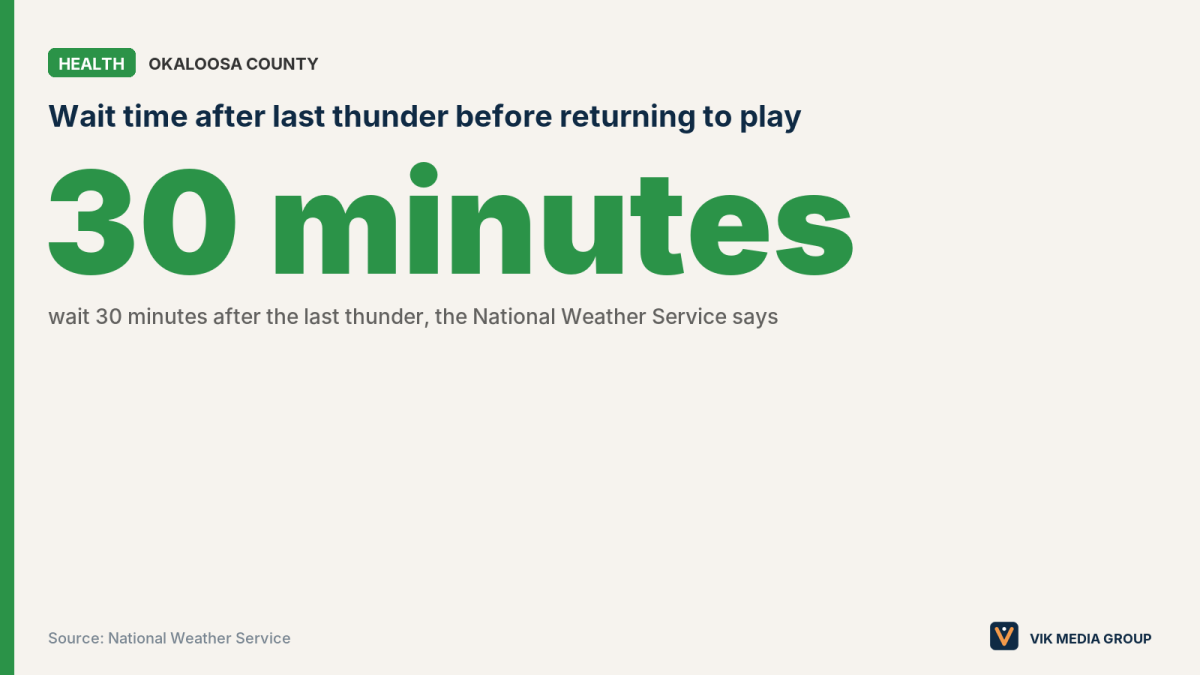
On an Emerald Coast golf course, the round should stop at the first sound of thunder: lightning can strike up to 10 miles from a storm, and the National Weather Service says to stay indoors until 30 minutes after the last thunder, per its lightning safety guide. Florida had 6 of the 13 lightning deaths in the U.S. in 2024, according to preliminary NWS figures, and 3 of 20 in 2025, according to the NWS Miami-South Florida office.
The weather service lists golf courses among the open places most exposed to lightning, along with ball fields, farms and construction sites. Summer is the risk season on the Emerald Coast: July and August average 7.2 and 8.1 days of measurable rain at the Destin-Fort Walton Beach Airport, the most of the year, according to NOAA’s 1991-2020 climate normals, and Florida’s summer rain comes mostly from afternoon thunderstorms.
What should golfers do when they hear thunder?
- Stop play as soon as you hear thunder. If you can hear it, you are close enough to be struck.
- Go inside a fully enclosed building with wiring and plumbing, such as the clubhouse.
- If no building is nearby, get into a hard-topped metal vehicle with the windows up.
- Do not shelter under trees, and stay away from open fairways, towers, utility poles and metal fences.
- Stay inside until 30 minutes after the last thunder.
Lightning often strikes before the rain arrives or after it seems to have ended, the NWS says.
Are golf carts and course rain shelters safe in lightning?
No. The weather service says sheds, picnic shelters, tents and covered porches give no protection from lightning, and no place outdoors is safe in a thunderstorm. An open golf cart or a rain shelter on the course falls in that group. A hard-topped car in the parking lot is safe; an open cart on the fairway is not.
How often are golfers killed by lightning?
From 2006 through 2019, lightning killed 418 people in the U.S., and 10 of them were golfing, according to an NWS analysis. Fishing accounted for 40 deaths and beach activities for 25, both common on the Emerald Coast. More than 70% of the deaths happened in June, July and August, and 79% of the people killed were male.
About 90% of people struck by lightning survive, the NWS says, but many live with lasting injuries.
When is lightning most likely on Emerald Coast golf courses?
| Month | Days with 0.10 in. of rain or more | Avg. rain (in.) |
|---|---|---|
| May | 3.7 | 3.22 |
| June | 6.1 | 4.70 |
| July | 7.2 | 5.77 |
| August | 8.1 | 6.08 |
| September | 5.3 | 5.18 |
| October | 3.5 | 2.82 |
Source: NOAA NCEI, U.S. Climate Normals 1991-2020, Destin Ft. Walton Airport (USW00053853).
The NWS Miami office ties Florida’s lightning to the near-daily afternoon thunderstorms of the rainy season and summer months. On the Emerald Coast, that points to morning tee times from June through September and a check of the forecast before a round.
What should I do if someone is struck?
- Call 911.
- A person struck by lightning does not carry an electrical charge and is safe to touch.
- Start CPR if you are trained; cardiac arrest is the most common immediate cause of death. Use an AED if the clubhouse has one.
- If possible, move the person to a safer place, because lightning can strike the same spot again.
This article explains federal safety guidance and is not medical advice.
Where do I check for storms before a round?
The National Weather Service office in Mobile, Ala., forecasts for Okaloosa, Walton and Santa Rosa counties, and the Tallahassee office covers Bay County. The NWS recommends checking the forecast and the Hazardous Weather Outlook before heading out, and planning ahead where to go if a storm develops.
- NWS lightning safety: weather.gov
- NWS Mobile climate summaries: weather.gov/mob
- Emergencies: 911
When thunder roars, go indoors.
Played here this week? Tell us how the course was: email our newsroom through the Contact link at the bottom of this page.
More Health & Medical guides and local services ›
Live in the Emerald Coast? Write for us as a Community Contributor and share what you see in your town.
Questions and answers
- Is it safe to stay in a golf cart during lightning?
- No. The National Weather Service says no place outdoors is safe in a thunderstorm and open shelters give no protection. Go into a building or a hard-topped car.
- How long should you wait after thunder to play golf again?
- 30 minutes after the last thunder, according to the National Weather Service.
- How many people died from lightning in Florida in 2024?
- Six of the 13 U.S. lightning deaths in 2024 were in Florida, according to preliminary National Weather Service figures.
- When are thunderstorms most common in Destin?
- In summer. July and August average 7.2 and 8.1 days of measurable rain at the Destin-Fort Walton Beach Airport, per NOAA 1991-2020 normals.