Emerald Coast restaurant reports: Florida codes for pests, temperature, licenses
Before you book a table on the Emerald Coast, open the restaurant’s Florida inspection report and look at four violation categories: 3 (time and temperature control), 35 (pests), 50 (license posted) and 53 (food manager certification). Then read the outcome line at the end, because it tells you whether the state needed to come back. The reports are public records kept by the Florida Department of Business and Professional Regulation (DBPR), which made 1,689 food service inspections at 1,356 places in Okaloosa, Walton, Santa Rosa and Bay counties from July 1 to Oct. 30, 2026.
What’s on a Florida restaurant inspection report?
DBPR’s Division of Hotels and Restaurants sorts what inspectors find into numbered violation categories, 1 through 58. Each violation is also graded high priority, intermediate or basic. The report lists the violations found that day, and the inspection ends with an official result.
That is a lot of detail for someone just picking a dinner spot, so it helps to know where to look first. The four categories below are a quick starting point, and the outcome line is the place to finish.
Which four violation codes are worth looking for?
These four categories use DBPR’s official names. Here is what each one means for a diner looking at a report.
| Category | Official name | What a diner is checking |
|---|---|---|
| 3 | Time and temperature control (marked by the state as a risk factor) | Whether food is held at the right temperature |
| 35 | Pests | Whether inspectors found signs of pests |
| 50 | License posted | Whether the restaurant’s license is posted |
| 53 | Food manager certification | Whether a certified food manager is on staff |
Category 3 is the one the state flags as a risk factor, so it stands out on the report. Categories 35, 50 and 53 are easy to scan for: a pest citation, a missing posted license or a gap in manager certification each shows up as its own line.
How often did serious violations turn up on the Emerald Coast?
Often enough that one violation on a report is common. In the 1,312 routine inspections in the four counties from July 1 to Oct. 30, 2026, inspectors cited 659 high priority violations, 755 intermediate violations and 1,559 basic violations, according to DBPR.
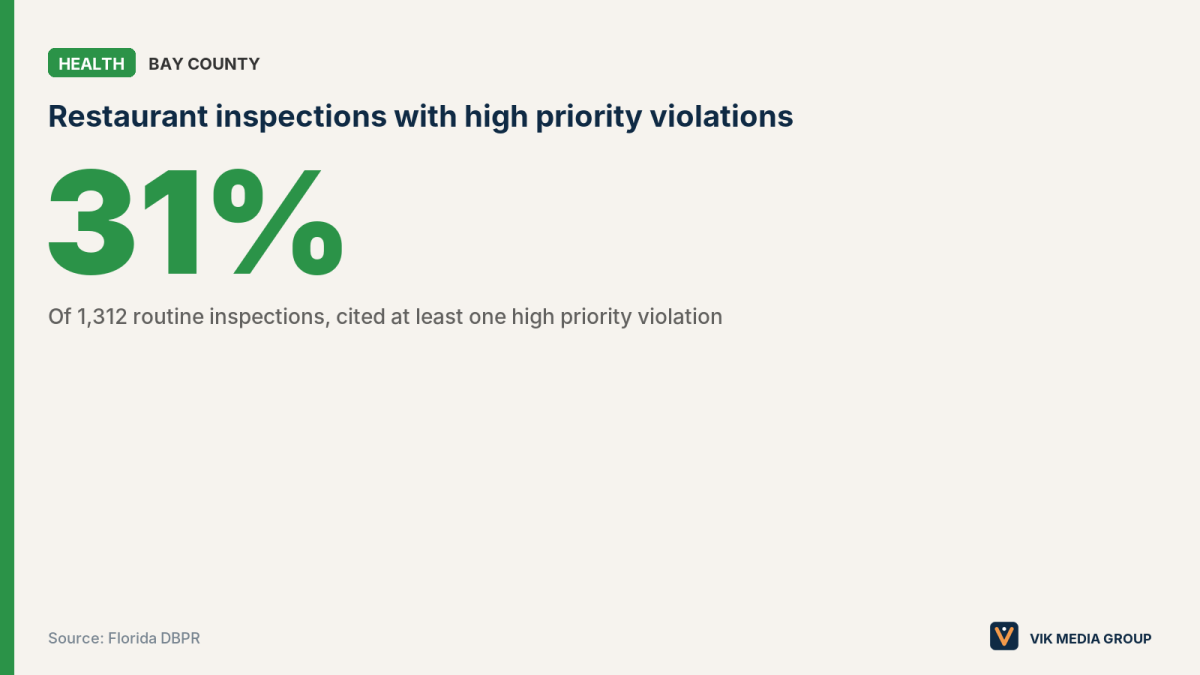
A total of 413 routine inspections, or 31%, found at least one high priority violation, and 62 of them found three or more. Yet 240 of those 413 still ended with no further action. Overall, 905 of the 1,312 routine inspections, or 69%, ended with no further action.
The takeaway: a single citation, even a high priority one, does not by itself mean the state came back. Read the outcome line too.
How do I read the outcome line?
Every inspection ends with a result, which DBPR calls a disposition. The state’s list includes:
- No further action
- Warning
- Callback
- Extension
- Administrative complaint
- Emergency order
- Emergency order callback complied or not complied
- Administrative determination
DBPR spells out each one on its inspection dispositions page, so check there for exactly what a given result means.
Here is the latest local picture, per DBPR’s file through Oct. 30, 2026. Of 1,356 places, 1,264 (93%) met standards on their latest result, and 92 were in follow-up. No place was listed as closed. Across all results from July 1, inspectors issued 205 warnings and recommended 53 administrative complaints. They also recommended 11 emergency orders at 10 places, and every one of those places reopened after a callback found the problems corrected.
Where do I look up a report, and how do I file a complaint?
Inspection records come from the Division of Hotels and Restaurants public records page.
Complaints can trigger inspections. Of the 1,689 inspections in the four counties, 272 (16%) were complaint inspections, and 8 of the 11 emergency orders came from complaints.
To file one, DBPR has an online complaint form for restaurants. You can also reach the Customer Contact Center at (850) 487-1395 or [email protected], or write to 2601 Blair Stone Road, Tallahassee, FL 32399. Complaints are public record unless a state exemption applies. DBPR says it cannot recover fees or seek remedies for diners.
Questions and answers
- Which violation codes should I check on a Florida restaurant inspection report?
- Start with category 3 (time and temperature control, which the state marks as a risk factor), 35 (pests), 50 (license posted) and 53 (food manager certification). Florida DBPR numbers its violation categories 1 through 58.
- Does a high priority violation mean a restaurant was shut down?
- No. Of 413 routine inspections in Okaloosa, Walton, Santa Rosa and Bay with at least one high priority violation from July 1 to Oct. 30, 2026, 240 still ended with no further action, per Florida DBPR. Check the outcome line on the report.
- How many Emerald Coast restaurants met Florida inspection standards on their latest visit?
- As of Oct. 30, 2026, 1,264 of 1,356 inspected places (93%) in Okaloosa, Walton, Santa Rosa and Bay counties met standards on their latest result, per Florida DBPR. The other 92 were in follow-up.
- How do I file a complaint about a restaurant in Florida?
- Use the online restaurant complaint form on the Florida DBPR website or call the Customer Contact Center at (850) 487-1395. Complaints are public record unless a state law exemption applies, and DBPR cannot recover fees or seek remedies for diners.